
Education
Home>Education
Our Summer Schools
AMC-Lahti organises two summer schools biennially. “First Steps In Biosphere-Atmosphere Modelling” focuses on developing a one-dimensional model including transport, emissions, chemistry, and aerosol dynamics. The second summer school, “AI Application In Atmospheric Science”, applies different AI methods to solve atmospheric chemistry. Below you will find more details about the two intensive summer schools.
First Steps in Biosphere-Atmosphere Modelling
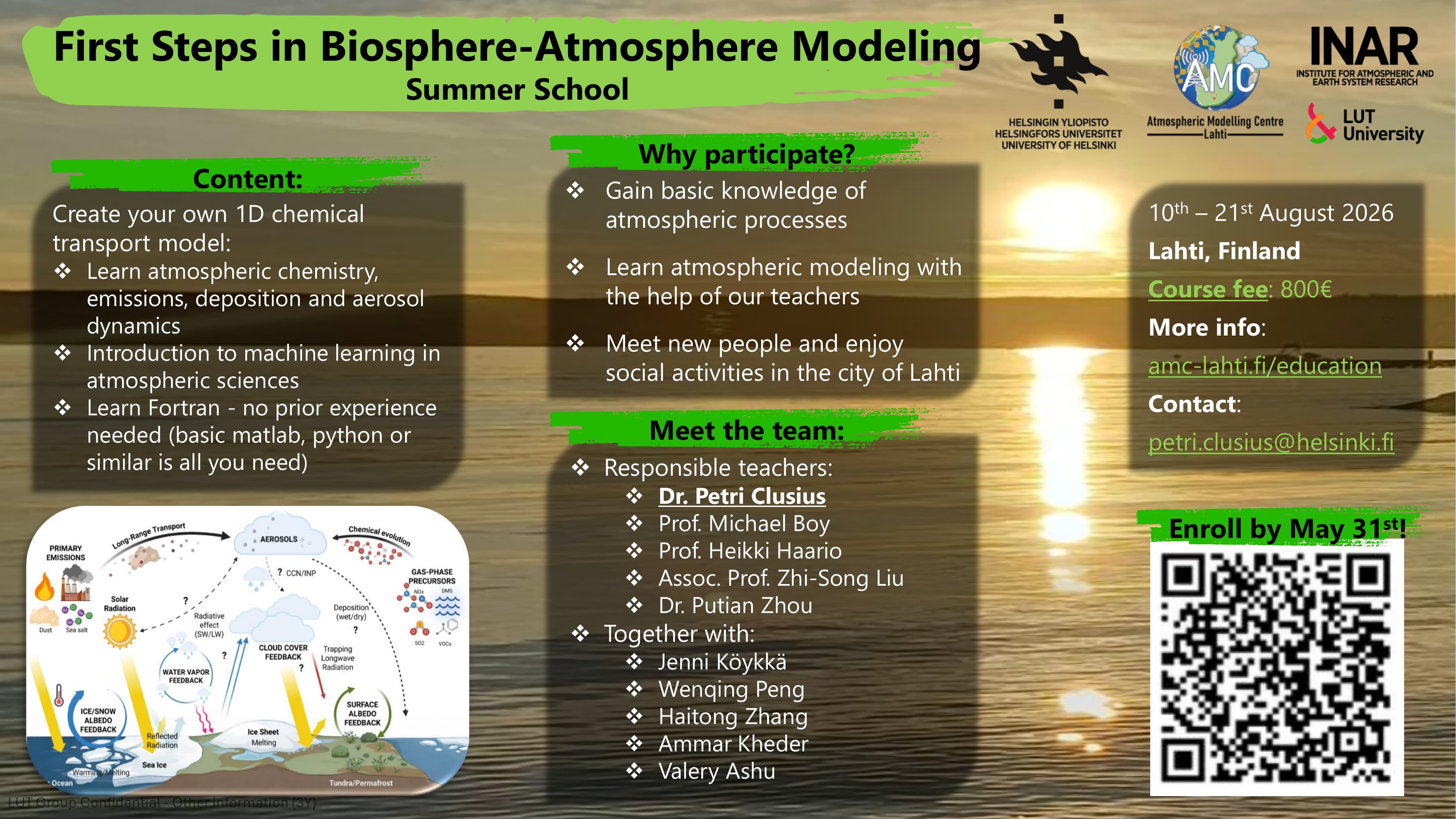
The next summer school, “First steps in biosphere-atmosphere modelling,” will be held in 10-21 of August 2026. (Lahti Campus)
Aim of the course
In this course, you will not run any existing model or analyse data from a model, but you will get a basic and detailed knowledge on how to write an atmospheric model from scratch. During the course, everyone will program his/her own 1-dimensional atmospheric boundary layer model with equations of flow for the atmospheric boundary layer, chemical kinetics by systems of differential equations, emissions of biogenic volatile organic compounds (BVOCs) from vegetation, deposition of gases and aerosols and numerical solutions for aerosol formation and growth. The model will be coded in Fortran 95, and basic programming knowledge in some computer languages (e.g. Fortran, C++, Python, Matlab) is required.
Information from earlier courses: If you want to know what earlier participants thought about the course or you want to see pictures from the former courses, please click here.
Course material: The lecture slides and additional material for the course are available here.
More information & registration →Deadline extended: 30 June 2026
AI Application In Atmospheric Science
The last summer school, “Application of AI/ML techniques in Atmospheric Science,” took place from 11 to 15 August 2025 at the University of Helsinki Lahti campus. The next one will be held in August 2027.
Aim of the course
This course will provide introductory lectures on relevant atmospheric topics (e.g., atmospheric chemistry, aerosol dynamics, Earth System models and numerical weather prediction) and computational methods (for data science and machine learning). Additionally, we will form mixed groups with different scientific backgrounds for the hands-on training, covering about half of the course time. Each group will use previously created atmospheric datasets in the exercises to train an end-to-end neural network, like LSTM, RNN, and Transformer. The students will learn basic GPU settings (Google Colab or local machines) and cuda-enable deep learning frameworks (PyTorch). We also provide advanced topics for highly motivated students, including data visualisation, analysis, and model optimisation.
Feedback from past participants:
- 2024 course: 21 participants, 11 provided anonymous feedback — see feedback (PDF)
- 2025 course: 25 participants, 13 provided anonymous feedback — see feedback (PDF)